Change is needed. After decades of association with government organizations, the relationship between leadership and constituents is often strained. Failure happens when the distrust grows to the point of dysfunction. Websites are not the solution, but they can be an important element in a strategy to keep leadership on course.
In my opinion, the greatest obstacle to effective leadership, management, and administration is the failure of a public information program.
It's a Communications Problem
When constituents don't understand the work of government organizations, conspiracy theories, doubts, accusations, and opposition suddenly emerge. When officials fail to understand constituents' needs, the government organization's plans and policies become fodder for accusations of malfeasance or misfeasance. While real corruption is relatively uncommon, it does exist. Ideally, the system purges corruption as information pinpoints the source and outcomes. Without information, corruption can go undetected for long periods.
How Websites Are the New Cornerstones of Communications
It seems obvious that the information on a website should be a valuable, reliable source for constituents. Unfortunately, that's not often true.
When Websites Fail to Inform Constituents
Many government websites list officials, departments, and roles. They may have great photographs of buildings and key officials. They may be a great sales brochure for the community, highlighting the best of what the community wants to believe about itself.
What's missing? People look to local government to lead them to a brighter, better future with taxes well spent, children educated, and citizens safe. It's too easy for government legislative bodies and officials to defer to private consultants to create "strategic" and long-range plans that overlook the community's needs. It's glitz rather than content put out for bid. Such websites get updated infrequently because the leadership is convinced that it has done its job.
Where a Website Starts Communications
I learn more about the local government by making my rounds to interview the key players. I learn what issues they face. Often, social media tells me what the leaders have not addressed to their constituents. The website offers a potent tool for informing the public about upcoming resolutions the commissioners, council members, or aldermen are considering. Online and monitored plans of different entities within the government body can paint a path to the future that the public otherwise misses. The analysis of website needs includes these plans and provides access to such public documents that are often available but virtually hidden.
So doesn't the availability of plans and proposed legislation complicate matters for officials trying to simplify their jobs? Absolutely, at first. Eventually, available public information serves to improve leadership and accountability.
One important attribute of websites often overlooked is the usage record they provide. During maintenance, webmasters, like me, see what people are looking for, how often they search for key information, and where they are when they access the website. By understanding such trends, government officials can adjust the available content to better inform their people and quell conspiracy theories and accusations.
Website development is a participatory process. When it ceases to be a webmaster's project, ownership transfers to the people running the local government offices. Pride and ownership of the information build loyalty and a sense of service that government employees need.
Government Technologies Needed
Some of the most important technologies include
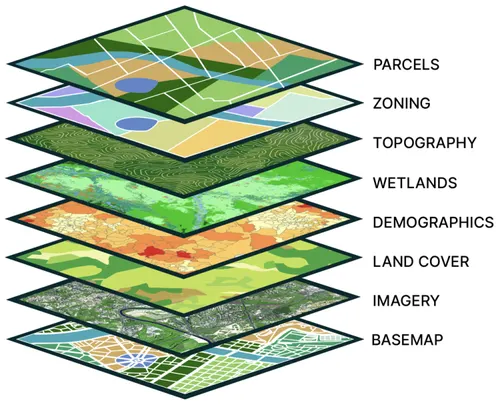 gis layers graphicGIS, Geographical Information Systems. In this technology, maps are linked to databases of information. The characteristics of elements on a map are linked with explicit locations. For example,
 - A system can tabulate the number of houses valued at more than $500,000 in any given area on the map.
- A utility department can locate reports of a water main break on a map and see the impacts on traffic.
- Developers and zoning officials can quickly determine if a proposed development or house lies within a permitted zoning area or urban growth area.
- A professional website builder can implement an interactive GIS mapping system within a government website.
- Help Desk. Citizens can report incidents and problems to responsible officials, track responses, and get feedback from government employees assigned to address the problems. Likewise, officials can track and report the progress in meeting customer needs from reports customers file.
- Video of Meetings. It's relatively easy to publish meetings online in real time for citizen involvement.
- Documents and Resource Information. Citizens, real estate agents, developers, and others can access ordinances, regulations, and resource information that affects their investments, developments, or living quality. My personal background was happy to see detailed soil maps available online for land use planning.